在许多在线平台上,�,�,�,,�,用户可以视察其他用户行为来学习,�,�,�,,�,并团结可能拥有的私人信息做出决议。�。。。。。一方面,�,�,�,,�,这种视察学习可能会导致用户选择“随大流”,�,�,�,,�,进而可能损害社会总效益。�。。。。。另一方面,�,�,�,,�,用户可能会视察到不可靠的效果,�,�,�,,�,好比部分用户说谎或者视察效果禁绝确。�。。。。。有趣的是,�,�,�,,�,近期研究发明,�,�,�,,�,在某些情形下基于不可靠视察的视察学习反而可以镌汰“随大流”征象的爆发。�。。。。。这类反直觉征象背后的实质缘故原由是什么呢??�???其关于在线平台的设计与优化又将带来怎样的洞见呢??�???
第七期 优德官网-TNSE 团结优异讲座系列运动,�,�,�,,�,我们约请美国西北大学的 Randall Berry 教授先容基于不可靠视察的视察学习,�,�,�,,�,并分享他在这个领域内的相关研究效果与有趣发明。�。。。。。
优德官网-TNSE Joint Distinguished Seminar Series is co-sponsored by IEEE Transactions on Network Science and Engineering (TNSE) and Shenzhen Institute of Artificial Intelligence and Robotics for Society (优德官网), with joint support from The Chinese University of Hong Kong, Shenzhen, Network Communication and Economics Laboratory (NCEL), and IEEE. This series aims to bring together top international experts and scholars in the field of network science and engineering to share cutting-edge scientific and technological achievements.
Join the seminar on March 31 through Bilibili (http://live.bilibili.com/22587709).
-
Jianwei Huang
Vice President, 优德官网; Presidential Chair Professor, CUHK-Shenzhen; Editor-in-Chief, IEEE TNSE; IEEE Fellow; AAIA Fellow
Executive Chair
-
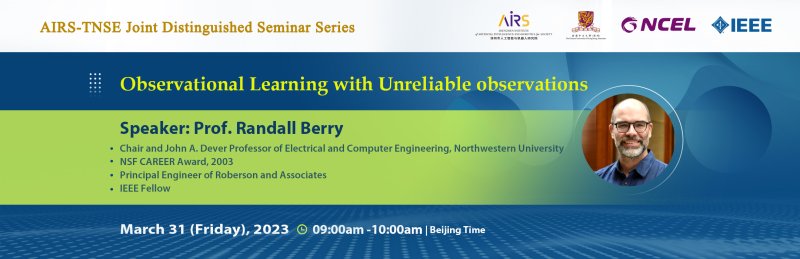
Randall Berry
Chair and John A. Dever Professor of Electrical and Computer Engineering, Northwestern University; NSF CAREER Award, 2003; Principal Engineer of Roberson and Associates; IEEE Fellow
Observational Learning with Unreliable observations
Randall Berry教授于2000年加入西北大学,�,�,�,,�,现任职电气与盘算机工程系主任,�,�,�,,�,也是该系的John A. Dever教授。�。。。。。他曾在麻省理工学院林肯实验室高级网络组担当手艺职员,�,�,�,,�,现在是Roberson and Associates公司的首席工程师。�。。。。。他在2003年获得了美国国家科学基金会事业奖(CAREER award from the National Science Foundation),�,�,�,,�,还于2014年获评IEEE Fellow。�。。。。。他是2015、2017年IEEE Workshop on Smart Data Pricing和2016年WiOPT的最佳论文奖获得者。�。。。。。Randall Berry教授曾担当TWC和TOIT的编辑,�,�,�,,�,现在是JCN的分区编辑以及OJ-COMS的领域编辑。�。。。。。他的研究兴趣涵盖无线通讯、盘算机网络、网络经济学和信息论。�。。。。。
Many online platforms enable agents to learn from observing other’s actions. Such observational learning can be modeled via a Bayesian game in which agents sequentially choose an action to take. Agents base their decision on whatever private information they may have as well as the observed actions of the other agents. Such models can lead to herding behavior or information cascades in which agents eventually “follow the crowd”. In this talk, we will discuss a line of work that considers the impact of different ways in which an agent’s observations may be corrupted including having some fraction of the agent’s lie about their action or having some fraction of the observations corrupted by noise. Interestingly, these models often show a non-monotonic behavior in the “level" of corruption, so that in some cases poorer observations may lead to better performance. We also discuss the relationship to the classic Blackwell ordering of information structures for single agent decision problems.